The Cadiretes massif, also known as the massif of Ardenya or of Sant Grau, is situated at the intersection of the regions of el Gironès and the coastal fringes of el Baix Empordà and la Selva. The area includes parts of the municipalities of Llagostera, Sant Feliu de Guíxols, Santa Cristina d'Aro, Caldes de Malavella, Lloret de Mar, Tossa de Mar and Vidreres. 3,223 Ha of this area is included within a plan of basic ecological protection under the Catalan Government's "Pla d'Espais d'Interès Natural".
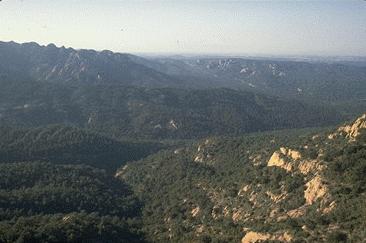 The granite substrata and coastal characteristics of the landform result in a particularly beautiful landscape. Its position gives an added value to its environmental qualities, as the massif is situated right in the middle of the Costa Brava, a zone which has been greatly altered by urban and road development. The Cadiretes massif is bordered by the Aro valley to the north. This is the main means of access to the principal tourist centres of Sant Feliu de Guíxols, Platja d'Aro and Palamós. To the south the massif extends down to the municipalities of Tossa de Mar and Lloret de Mar. These are also very popular villages for tourists, especially during summer months. Within the coastal zone of the massif there are various urban areas which have been excluded from the ecological protection plan. Amongst these are the bays of Canyet, Salions and Giverola.
The highest point of the landform is the peak of Cadiretes, with an altitude of 518 m, followed by el Montagut of 505 m, Ventós of 423 m (at the eastern end of the massif) and el Montclar and les Cols, both of 417 m altitude. The small valleys and hollows of the massif are furrowed with river-beds, which are dry during summer. Due to the type of terrain, however, there are springs which provide water throughout the year. This water, combined with the high level of humidity and the rain induced by the easterly winds rising above the wall of the massif, means that flora and fauna typical of central-european zones are also found here. The interlocation of central-european species with genuinely mediterranean communities constitutes one of the principal ecological attractions of the zone. In the southern half of the zone, besides the small streams that open directly into the sea, there is the drainage network of the Tossa river. Important in the north is the Ridaura river, although this runs into the Aro valley early in its course.
The coast, with a total of 6 km under preservation, is particularly abrupt, providing shelter for some notably scarce species. The strong waves and clean waters allow the development of algal communities at considerable depths, in contrast to the Medes islands, for example.
To get to know the area we suggest taking the winding road from Sant Feliu de Guíxols to Tossa de Mar. This road traverses the massif from north to south along the coast. Along the whole length of this route one sees urban zones alternating with protected forest areas and sea cliffs. At the level of Salions bay a road divides off which crosses the mountain in a westerly direction till the village of Llagostera. Taking this road, one reaches the hermitage of Sant Grau, in amongst forests, from which there is a magnificent view. On the peak of Sant Baldiri, in the area of Sant Cristina d'Aro, one can visit the baroque hermitage of Sant Baldiri, now partially in ruins.
Another interesting place is the area of Pedralta, at the border between the zones of Sant Feliu de Guíxols and Santa Cristina d'Aro. Apart from enjoying an excellent view of the Ridaura valley, one can see here a good example of the forests which are characteristic of the zone. Here, outcrops of eroded granite blocks lie in amongst the cork oak forest. One spectacularly large example of these granite blocks measures 6 m in height, 4 m in length and 3.5 m in width and weighs more than 30 tonnes. This stone balances on a 10 m high base. The peaks of el Montclar, el Montagut and Cadiretes can be reached on foot via a series of tracks. From each of these peaks there are wonderful views of the whole massif and the Mediterranean.
One of the main problems for the Cadiretes massif is the large number of people in the surrounding zones. Its location in an area of heavy tourist activity brings with it alterations to its flora and fauna communities, both terrestrial and marine. Fortunately the administration of this attractive part of the Costa Brava serves to regulate and guide the development of suitable recreation activities as a complement to the tourist activities in the villages.